 Skip to main content

What Is a Gastroscopy? When do you need it?
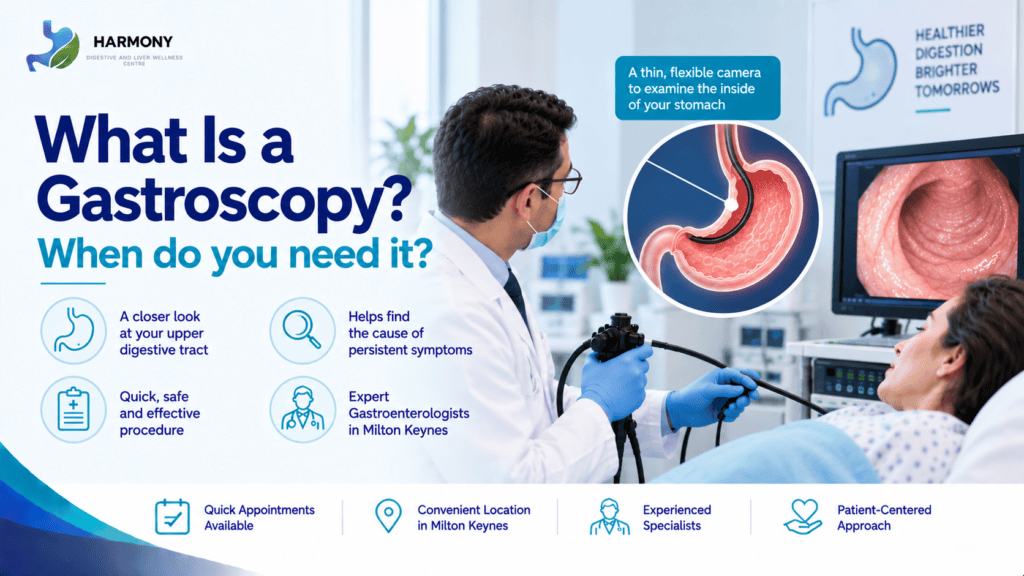
By Dr Arjun Prakash, Consultant Gastroenterologist If you’ve been told you need a gastroscopy, there’s a good chance your first reaction wasn’t relief. It was probably Google. And Google, as it tends to do, gave you something to worry about. So let me tell you what I tell my patients when they sit across from me, phone already in hand: What Is a Gastroscopy? It’s one of the most straightforward investigations we have. It’s brief, it’s well-tolerated, and more often than not, it gives people answers they’ve been quietly waiting for. What Is a Gastroscopy? What is a gastroscopy, in plain terms? It’s a gentle, direct look inside your oesophagus, stomach, and the upper part of your small intestine – using a thin, flexible tube with a small camera at the tip. The whole thing takes around ten to fifteen minutes. You’re given either a throat spray or light sedation, and most patients tell me afterwards they barely noticed it happening. It’s sometimes called an upper endoscopy or OGD. The medical name is long. The experience, thankfully, isn’t. Why Your Symptoms Deserve a Proper Answer Digestive discomfort has a way of becoming background noise. You get used to the bloating. You keep antacids in your bag. You tell yourself everyone deals with reflux. And maybe they do, but that doesn’t mean yours should go uninvestigated. The upper digestive tract is one part of the body we simply cannot assess from the outside. Blood tests, scans, and symptom questionnaires all have their place – but none of them shows the lining of your stomach. Only a camera does that. And what it finds changes everything: a peptic ulcer, gastritis, Barrett’s oesophagus, coeliac disease, or occasionally something that needs urgent attention. Most of the time, what it finds is reassurance. That matters too. When to Stop Waiting and Get Checked You don’t need to be in crisis to deserve an investigation. But there are symptoms I take seriously straightaway, and I want you to take them seriously too: Food that sticks or feels like it’s getting caught when you swallow Heartburn or reflux that keeps coming back despite medication Unexplained weight loss, even if it seems small Persistent nausea or vomiting – especially with any blood present A dull, recurring ache in the upper abdomen that antacids don’t touch Iron-deficiency anaemia that no one has fully explained I’d also gently say this: if you’re over 45 and experiencing new digestive symptoms that feel different from what you’ve had before, please don’t dismiss them. The age threshold exists for a reason. What the Experience Is Actually Like I want to address the anxiety directly, because it’s real and I hear it often. Most patients choose sedation – a light dose that leaves you drowsy, relaxed, and with very little memory of the procedure itself. You won’t be put to sleep. You’ll simply feel calm. The camera passes while you breathe normally. There’s no cutting, no stitches, and you’ll be home within a couple of hours. Afterwards, you might notice mild bloating or a faint throat soreness. That typically settles by the same evening. If anything unusual is seen – an inflamed patch, a small growth, tissue that looks different – a biopsy can be taken at that same moment. No second appointment. No waiting to find out if something needs sampling. One visit does the work. More Than Just a Diagnosis What I want patients to understand is that gastroscopy isn’t only about finding problems – it’s also about fixing them. Bleeding ulcers can be treated during the procedure. Polyps can be removed. Narrowed sections can be opened up. In many cases, the investigation and the intervention happen in the same room, on the same day. A Final Word If you’ve been managing symptoms for months — or years — and never been properly investigated, I understand why. Life is busy. Symptoms come and go. It feels easier to cope than to question. But coping isn’t the same as understanding. And understanding, especially what is a gastroscopy, when it comes to your digestive health, can make an enormous difference — not just medically, but in how you feel day to day. A gastroscopy is a short procedure. The peace of mind — or the early diagnosis — it provides can last much longer. At Harmony Digestive and Liver Wellness, we walk you through every step before, during, and after your gastroscopy – so you’re never left with unanswered questions or a report you have to decode alone. Book a consultation or screening today: Click Here. To book a private liver or gut consultation or second opinion, Get in touch with us. Had a great experience with us? We’d love to hear your thoughts! Click here to leave a Google review.
What Is SIBO? Symptoms, Causes & Treatment Explained
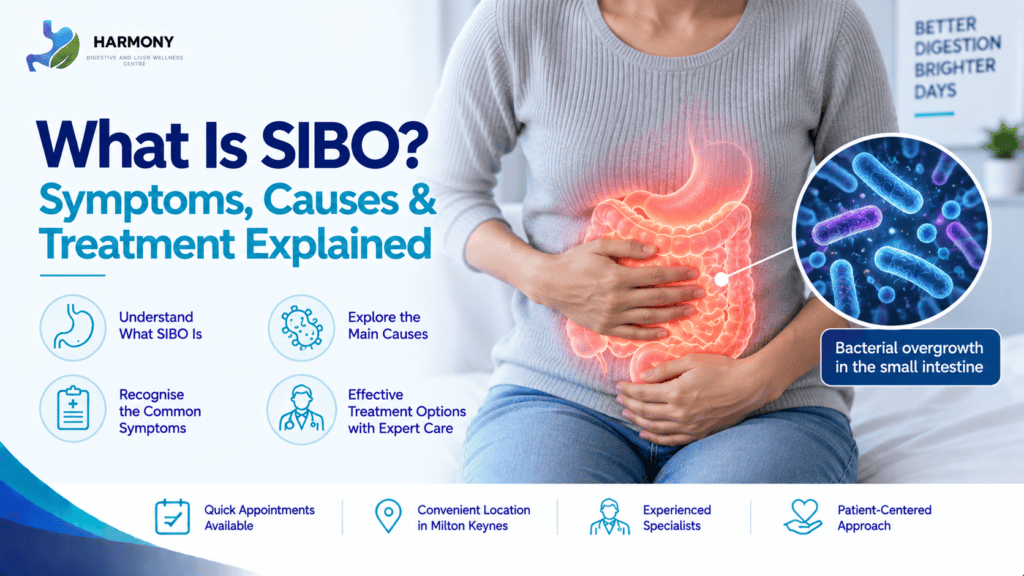
If you’ve been bloated after every meal, dealing with unpredictable bowel habits, and getting nowhere despite cutting out food after food, there’s a condition most people haven’t heard of that could explain everything. It’s called SIBO: Small Intestinal Bacterial Overgrowth. It’s underdiagnosed, frequently mistaken for IBS, and in most cases, very treatable. The problem is simply getting to the right diagnosis. I’m Dr Prakash Gupta, a Consultant Gastroenterologist. SIBO is underdiagnosed, frequently misattributed to IBS, and in most cases, very treatable. The problem is simply getting to the right diagnosis. What Exactly Is SIBO? Your digestive system hosts trillions of bacteria — mostly beneficial, but location matters. Your large intestine is built to handle high bacterial populations. Your small intestine is not. SIBO occurs when bacteria migrate upward and colonise the small intestine in numbers it can’t manage. Once there, they ferment your food before your body absorbs it properly — producing excess gas, inflammation, and a gut that feels permanently off. This isn’t a traditional infection. It’s the wrong organisms in the wrong place. Symptoms of SIBO: What to Look For SIBO doesn’t tend to announce itself with one dramatic symptom. It’s usually a cluster of things that have been building for months — sometimes years. The most common ones I see: Persistent bloating, particularly after meals — often described as a ‘balloon’ sensation that builds throughout the day Abdominal discomfort, cramping, or a general sense of pressure in the gut Unpredictable bowel habits — this can mean constipation, loose stools, or both alternating Excessive gas and flatulence that seems out of proportion to what you’ve eaten Unexplained fatigue — when your gut isn’t absorbing nutrients efficiently, the rest of your body feels it In longer-standing cases: deficiencies in B12, iron, or fat-soluble vitamins (A, D, E, K) You may find that certain foods — particularly those containing onions, garlic, legumes, or wheat — seem to make things significantly worse. This is because these foods are rapidly fermented by bacteria, and in SIBO, there are far too many bacteria to manage that fermentation process properly. What Causes SIBO? In most cases, SIBO develops because something has disrupted the small intestine’s ability to keep bacteria moving through and prevent them from settling in. A few of the most common underlying mechanisms: Sluggish gut motility — The small intestine uses rhythmic contractions (the migrating motor complex) to sweep bacteria forward. When this slows — common in diabetes, thyroid conditions, or after abdominal surgery — bacteria accumulate. Low stomach acid — Acid is a frontline defence against bacterial overgrowth. Long-term use of PPIs like omeprazole quietly erodes that protection without most people realising. Structural changes — Surgical adhesions or strictures create stagnant zones were bacteria multiply unchallenged. Post-infectious damage — A single serious bout of food poisoning or gastroenteritis can permanently alter gut motility, leaving the small intestine sluggish and vulnerable long after recovery. Treatment: What Actually Works A simple hydrogen and methane breath test — no needles, no hospital. You fast overnight, drink a sugar solution, and breathe into tubes for over two hours. Elevated gas readings confirm overgrowth. Treatment: Rifaximin is the first-line antibiotic — works directly inside the gut, barely enters the bloodstream Minimal side effects compared to standard antibiotics Most patients notice real improvement within two weeks For methane-dominant SIBO, a second antibiotic is often added for better results The root cause must be addressed — motility, acid suppression, or structural issues — or SIBO returns A low-FODMAP diet runs alongside antibiotics to reduce foods that feed bacterial fermentation Low-FODMAP is short-term only — not a permanent diet, but genuinely helpful during recovery Full symptom resolution typically happens within a month of completing treatment A Final Word If you’ve had ongoing digestive symptoms, a normal colonoscopy, and no clear diagnosis — that’s the pattern that should prompt a SIBO conversation. You don’t need to have every symptom on the list. If bloating after meals, unpredictable bowel habits, and persistent gut discomfort have been part of your life for more than a few months — especially if standard investigations haven’t given you answers — it’s time to look further. At Harmony Digestive and Liver Wellness, we offer breath testing and thorough gut investigations, with findings explained in plain language. Book a consultation or screening today: Click Here. To book a private liver or gut consultation or second opinion, Get in touch with us. Had a great experience with us? We’d love to hear your thoughts! Click here to leave a Google review.
Does IBS Cause Bloating? When is it IBS and when should it be investigated?
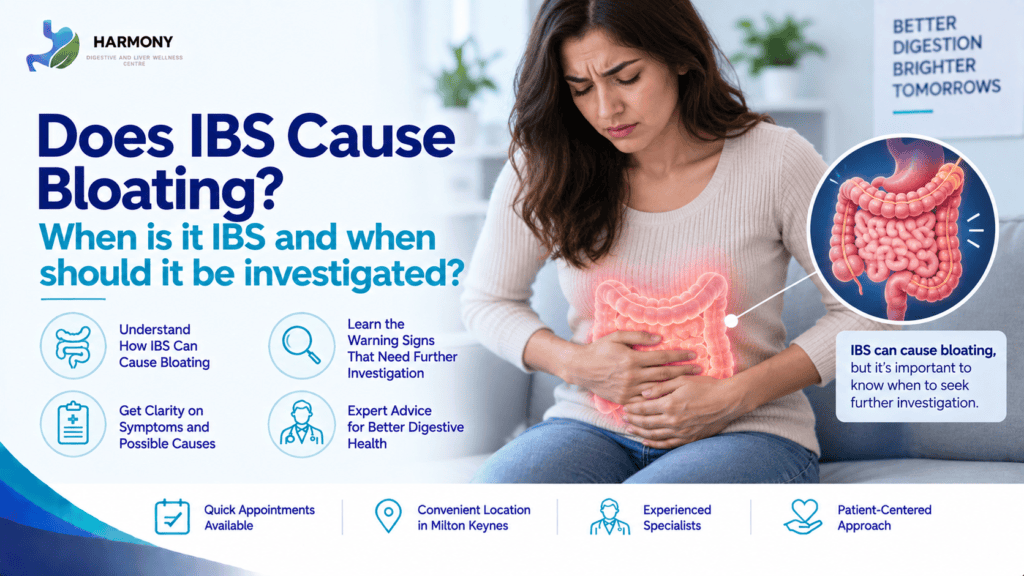
Bloating gets blamed on everything. Too much bread. Eating too fast. A stressful week. And sometimes, that’s exactly what it is. But when it keeps coming back – week after week, meal after meal – it deserves a more careful answer. Does IBS cause bloating? Yes, it does. IBS is known to cause bloating, often in the form of fullness, pressure, or visible distension. I’m Dr Arjun Prakash, a Consultant Gastroenterologist. If you’ve been living with persistent bloating and told there’s nothing to investigate, this is worth reading. Because the answer isn’t always IBS – and even when it is, IBS deserves better than a label with no plan behind it. What Is IBS – and Does IBS Cause Bloating? Irritable bowel syndrome is a functional gut condition – meaning the bowel looks structurally normal, but behaves abnormally. The gut becomes hypersensitive, reacting disproportionately to ordinary amounts of gas, food, or movement. The result is a pattern of symptoms: abdominal discomfort, unpredictable bowel habits, and yes – bloating. So does IBS cause bloating? It does. Patients describe it as fullness, pressure, or visible distension – often building through the day and worsening around meals or periods of stress. But here’s what matters clinically: IBS is a diagnosis of exclusion. Before that label is applied, other causes need to be confidently ruled out. Bloating is equally a feature of coeliac disease, small intestinal bacterial overgrowth (SIBO), inflammatory bowel disease, ovarian conditions, and – in cases that cannot be missed – early gastrointestinal malignancy. What IBS Bloating Actually Feels Like IBS-related bloating tends to follow a recognisable pattern. It: Fluctuates – better some days, worse on others Worsens after eating, particularly foods high in fermentable carbohydrates (FODMAPs) Is linked to a change in bowel habit – either loose stools, constipation, or alternating between the two Improves, at least partially, after opening the bowels Tracks closely with stress, anxiety, or disrupted sleep A diagnosis of IBS should never be the end of the conversation. It should be the beginning of one – with a clear management plan, not just a name for what you’re experiencing. When Bloating Needs More Than Reassurance This is where I ask patients to pay close attention. Certain features alongside bloating suggest the gut needs investigating beyond a clinical consultation alone: Unintentional weight loss – even a few kilograms over a few months Rectal bleeding or blood mixed into stools Bloating that is constant rather than fluctuating – a distension that doesn’t ease overnight New bloating in someone over 50 with no prior gut history Waking at night with abdominal discomfort A family history of bowel cancer, ovarian cancer, or inflammatory bowel disease Any one of these changes the conversation. These aren’t IBS features. They’re red flags – and they warrant urgent specialist review. How We Actually Investigate It A thorough workup for persistent bloating starts with blood tests: inflammatory markers, coeliac antibodies, thyroid function, and a full blood count. Stool calprotectin tests can distinguish functional gut symptoms from active inflammation with high accuracy. Depending on findings, the investigation may extend to a colonoscopy, a hydrogen breath test for SIBO, or cross-sectional imaging. The right pathway depends on the full clinical picture – which is why a specialist consultation is the most efficient route to answers. A Final Word Does IBS cause bloating? Yes. But bloating causing you concern deserves more than a label. It deserves a clear diagnosis, a proper exclusion of other causes, and a management plan that actually works. If your bloating is persistent, worsening, or comes with any of the red-flag features above, don’t wait it out. At Harmony Digestive and Liver Wellness, we offer a complete gut assessment – from blood and stool tests to endoscopy and specialist review – with every result explained clearly. Book your consultation here. Book a consultation or screening today: Click Here. To book a private liver or gut consultation or second opinion, Get in touch with us. Had a great experience with us? We’d love to hear your thoughts! Click here to leave a Google review.
Liver Function Blood Test: Do normal liver function blood test rule out liver disease?
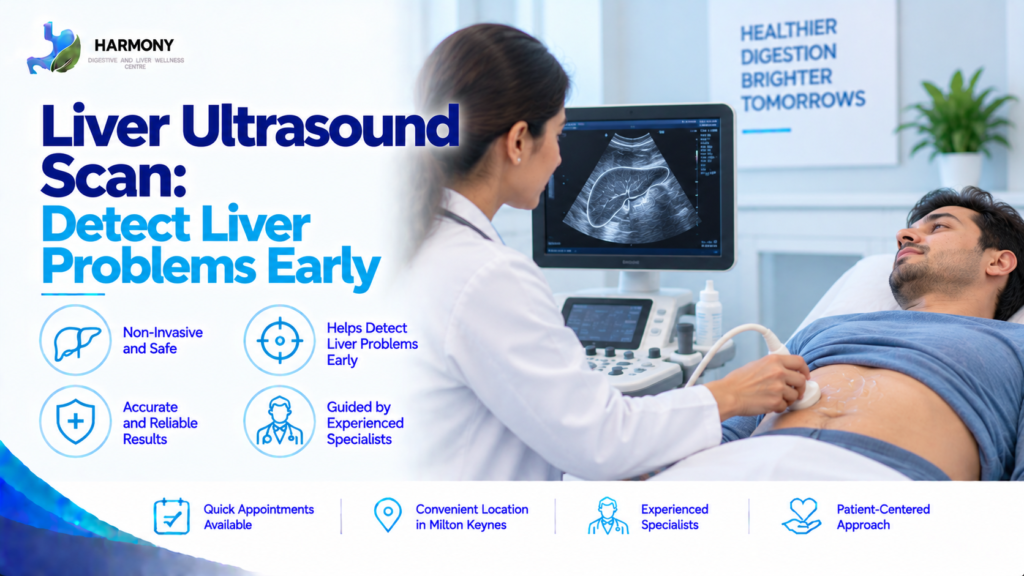
Normal doesn’t mean healthy. In liver medicine, it sometimes just means we haven’t looked closely enough yet. The patient sitting across from me has done everything right. They got tested. The results looked fine. Their GP wasn’t concerned. And yet here they are – because something still doesn’t feel right, and it turns out their instinct was correct. I’m Dr Prakash Gupta, a Consultant Gastroenterologist. The liver function blood test is one of the most ordered tests in medicine – and one of the most misread. Here’s what those results actually tell you, and what they quietly leave out. What a Liver Function Blood Test Actually Measures A standard liver function blood test checks a panel of enzymes and proteins: ALT, AST, ALP, GGT, bilirubin, albumin, and total protein. These markers tell us how the liver is performing certain jobs – processing waste, making proteins, and clearing bilirubin. What they don’t tell us is the full story. Each marker reflects a narrow slice of liver health. And crucially, they reflect the liver right now – not the slow, silent damage that may have been accumulating for years. The Problem With “Normal” Here’s the part that surprises most patients: a liver function blood test can appear entirely normal even when significant liver disease is already present. In conditions like early fatty liver (NAFLD/MASLD), liver enzymes often sit comfortably within the normal range – even when ultrasound or elastography reveals fat accumulation or early fibrosis. In hepatitis C, some patients carry the infection for decades with near-normal liver enzymes while the virus quietly scars the liver. In cirrhosis, once the liver has already lost a significant portion of its functional tissue, enzyme levels can paradoxically normalise – because there are fewer healthy cells left to release them. A normal result means the liver isn’t shouting. It doesn’t mean the liver isn’t struggling. What “Raised” Enzymes Actually Mean If your liver function blood test does show elevated enzymes, that’s worth taking seriously – but raised levels alone don’t tell you why. ALT and AST can be elevated in fatty liver, viral hepatitis, alcohol-related liver disease, medication effects, thyroid problems, and even vigorous exercise. Context matters enormously. A mildly raised result brushed off as “nothing to worry about” without further investigation is a missed opportunity. A significantly elevated result that gets traced, investigated, and treated can genuinely change the outcome. What Needs to Come Next A liver function blood test is a starting point, not an endpoint. If your results are abnormal – or if you have risk factors even with normal results – the investigation needs to go further. That typically means: A liver ultrasound, which can detect fatty change, structural abnormalities, and lesions that blood tests simply cannot. Elastography (FibroScan), which measures both the amount of fat in the liver and the degree of scarring – two pieces of information that change clinical decisions entirely. Targeted blood tests, including viral hepatitis screens, autoimmune markers, and iron studies, depending on the clinical picture. The liver function blood test opens the door. These tests tell you what’s actually behind it. Who Should Go Further – Even With Normal Results If any of the following apply to you, a normal liver function blood test is not sufficient reassurance on its own: You have type 2 diabetes or insulin resistance You carry excess weight, particularly around the abdomen You have high triglycerides or metabolic syndrome You drink alcohol regularly, even at moderate levels A family member has been diagnosed with liver disease You’ve had a fatty or enlarged liver noted on a previous scan In these situations, I recommend a full liver assessment regardless of what the blood panel shows. A Final Word Early liver disease is treatable. Cirrhosis is not reversible. The liver function blood test is a valuable tool – but placing too much reassurance in a normal result can create a false sense of safety in exactly the patients who need further investigation most. If you have risk factors, or if something about your health doesn’t add up, don’t stop at the blood test. At Harmony Digestive and Liver Wellness, we offer a comprehensive liver assessment – blood panels, ultrasound, and FibroScan – interpreted together, in one visit. Book your consultation here. Book a consultation or screening today: Click Here. To book a private liver or gut consultation or second opinion, Get in touch with us. Had a great experience with us? We’d love to hear your thoughts! Click here to leave a Google review.
Can Fatty Liver Be Reversed? Effective Ways to Improve Liver Health
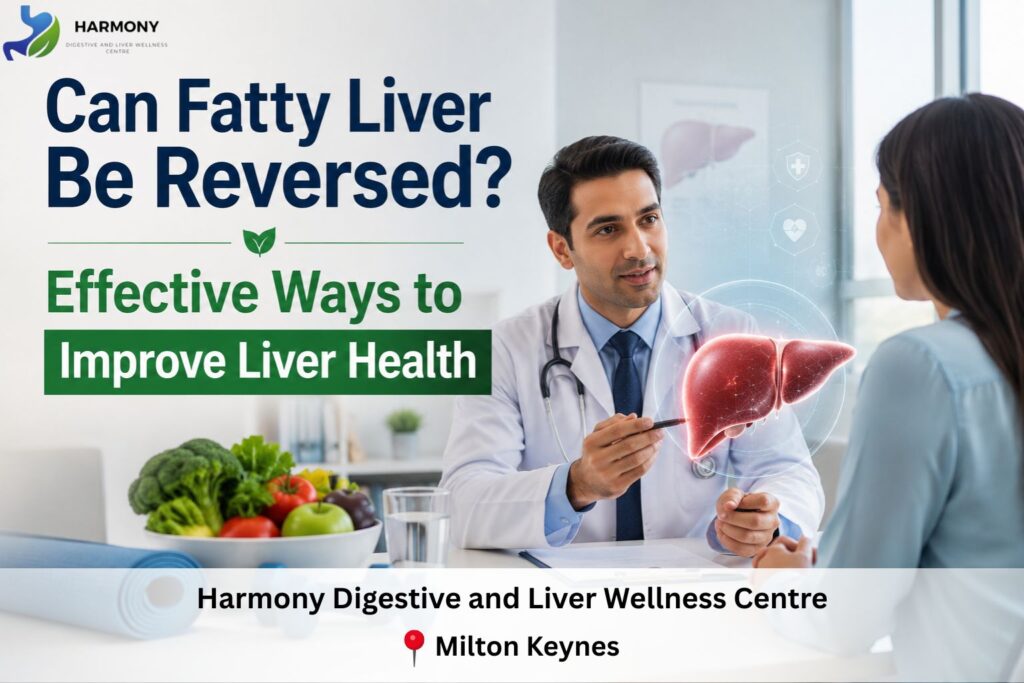
You have just been told you have fatty liver — and the first thing you want to know is whether this is permanent. I am Dr Arjun Prakash, Consultant Gastroenterologist and Hepatologist. The most common question I hear after a fatty liver diagnosis is simple: Can fatty liver be reversed? For most people who act early, the answer is yes. Why It Often Goes Unnoticed Fatty liver builds up quietly. Fat accumulates within liver cells, gradually making the liver work harder — and in many cases, patients feel nothing unusual at all. No pain, no obvious warning. The diagnosis often arrives through a routine blood test or abdominal scan, which is why an abnormal liver test result should always be taken seriously and followed up properly. Can Fatty Liver Be Reversed? In the early stages, yes. The liver has a strong capacity to heal itself when the right changes are made in time. Once liver fibrosis begins — meaning scar tissue starts to form — reversal becomes harder, though slowing progression and achieving partial recovery is still possible. At the stage of advanced cirrhosis, the goal shifts to careful management rather than reversal. This is why knowing exactly where you stand matters. A liver function test, a liver ultrasound scan, and a FibroScan assessment can map out the current state of your liver — painlessly and quickly. The earlier we look, the more we can do. What Actually Makes a Difference There is no single pill that reverses fatty liver. What works is a combination of consistent, practical changes. Losing weight steadily: For patients carrying excess weight, losing five to ten percent of body weight can meaningfully reduce liver fat. Gradual loss matters here — crash dieting puts additional stress on the liver rather than relieving it. Changing what you eat: A fatty liver disease diet focused on vegetables, whole grains, oily fish, and healthy fats works well. Cutting back on processed foods, added sugars, and refined carbohydrates reduces the daily burden on the liver. A diet that supports liver repair does not need to be complicated — it just needs to be consistent. Reducing alcohol: Even in non-alcoholic fatty liver, alcohol adds unnecessary pressure to an already strained organ. For alcohol-related liver disease, cutting back — or stopping — is the most important step of all. Regular physical activity: Regular moderate exercise, even thirty minutes of walking most days, helps the body burn stored fat, including liver fat. You do not need to do anything extreme. Looking after your gut: The gut and liver are closely connected. An imbalanced gut directly contributes to liver inflammation. Working on how to improve gut health supports liver recovery in ways many patients do not initially expect. A Word on Acting Early Patients sometimes tell me they wish they had come sooner. Early signs of liver disease are subtle, and it is easy to explain away fatigue or mild discomfort. But early-stage fatty liver, identified and addressed promptly, carries a genuinely good prognosis. Waiting until symptoms become more obvious means waiting until the disease has progressed further — and that narrows the options we have available. A Final Word At Harmony Digestive and Liver Wellness, we offer specialist liver assessment, including liver function testing, liver ultrasound, FibroScan-style liver stiffness evaluation, and consultant-led interpretation of your results. If you have been told you have fatty liver, received an abnormal liver blood test result, or are simply concerned about your liver health, please do not wait. Can Fatty Liver Be Reversed? With early assessment, the right lifestyle changes, and expert medical guidance, fatty liver can often be managed effectively before it leads to serious complications. Early assessment can make a significant difference to your long-term outlook — and we are here to guide you through every step of that process. Book a consultation or screening today: Click Here. To book a private liver or gut consultation or second opinion, Get in touch with us. Had a great experience with us? We’d love to hear your thoughts! Click here to leave a Google review.
FibroScan vs Ultrasound: Understanding the Key Differences
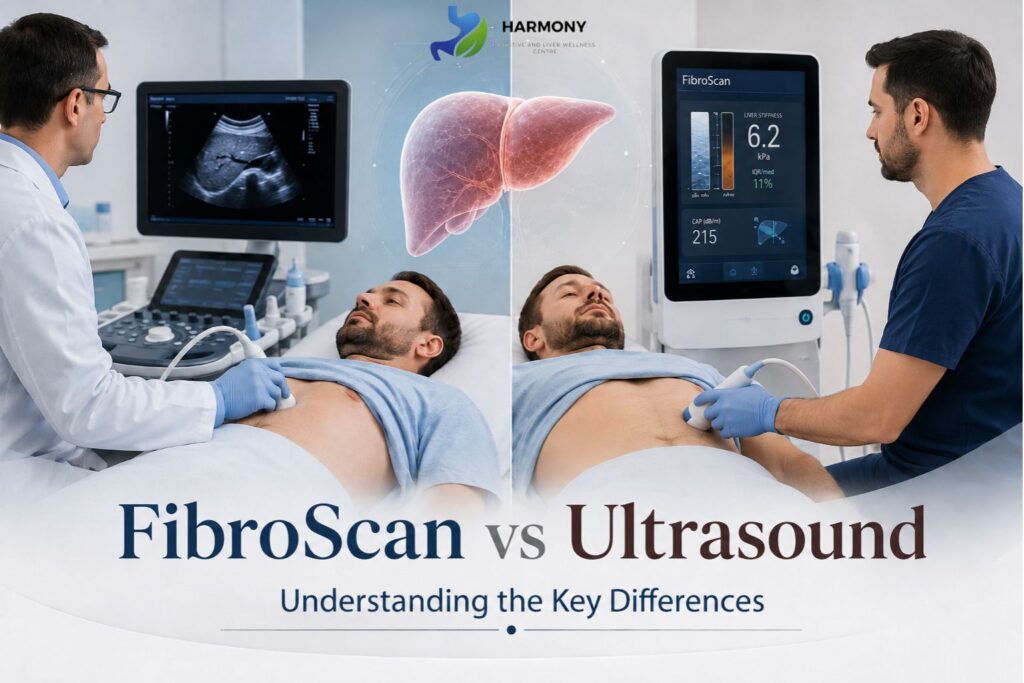
You’ve probably heard both terms mentioned — FibroScan vs Ultrasound — and wondered whether they’re the same thing, or why your doctor might recommend one over the other. It’s a question I get asked a lot in the clinic. I’m Dr Prakash Gupta, Consultant Gastroenterologist and Hepatologist at Harmony Digestive and Liver Wellness. Let me explain the difference in straightforward terms, because it genuinely matters for how we look after your liver. What a Liver Ultrasound Actually Does Most people have had an ultrasound at some point. It’s the same technology used in pregnancy scans — sound waves that bounce off tissue and create an image on screen. The liver gives us a visual overview of the organ. A liver ultrasound is useful for spotting: Obvious fatty changes or an enlarged liver Gallstones and bile duct problems Liver cysts or masses Signs of structural abnormality It’s a good starting point. If you’ve come in with abnormal liver blood tests or unexplained abdominal symptoms, an ultrasound is often the first thing I’ll arrange. But here’s what most patients aren’t told: a standard ultrasound cannot measure scarring inside the liver. It can tell me your liver looks fatty, or slightly enlarged, or a little irregular — but it can’t tell me whether there’s significant fibrosis building up beneath the surface. And that, unfortunately, is often the thing that matters most. What a FibroScan Does Differently FibroScan — the medical term is transient elastography — was developed specifically to fill that gap. It measures how stiff the liver is. Stiffness and scarring go hand in hand: the more fibrosis that has built up over time, the stiffer the liver becomes. The way it works is quite elegant. A small probe sits against your skin, just below the ribs on the right side. It sends a gentle vibration into the liver and measures how quickly that vibration travels through the tissue. A soft, healthy liver slows it down. A stiff, scarred liver lets it pass through faster. The machine converts that into a number — expressed in kilopascals — and that number tells us a great deal about where things stand. Here’s what the experience is actually like for patients: The whole test takes around 10–15 minutes There are no needles and no sedation You just need to avoid eating for 2–3 hours beforehand Results are available straight away Most patients tell me they were surprised by how unremarkable it was So Which One Do You Actually Need? The honest answer is: it depends on what question we’re trying to answer. A liver ultrasound is the right tool when: We want a structural overview of the liver and surrounding organs There’s a concern about gallstones, masses, or obvious fatty changes It’s a first-step investigation for new symptoms or raised blood tests A FibroScan is the right tool when: We need to know how much scarring or fibrosis is actually present We want to stage liver disease and monitor whether it’s progressing The ultrasound has flagged something, and we need to understand it better For many patients, both have a role. An ultrasound might be the first step, and FibroScan follows to stage whatever has been found. If you’re also dealing with digestive symptoms alongside your liver concerns — bloating, discomfort, changes in bowel habit — it’s worth reading about gut inflammation symptoms, because the two are sometimes connected. Why This Distinction Actually Matters Liver disease is, frustratingly, often silent. I see patients in the clinic who feel absolutely fine and are shocked to learn they have significant fibrosis. By the time symptoms show up — fatigue, jaundice, fluid retention — the liver can already be under considerable strain. You may benefit from liver stiffness testing if you have: Fatty liver was identified on a previous ultrasound Raised liver enzymes or abnormal liver blood tests Type 2 diabetes or metabolic syndrome Significant or regular alcohol intake A history of hepatitis B or C Obesity or high cholesterol A family history of liver disease Even if you feel entirely well, any of these risk factors is a good reason to get a clearer picture. Early fibrosis can often be stabilised or reversed. Once liver disease reaches an advanced stage, the options narrow significantly — and that shift can hinge on whether the problem was caught at the right time. Thinking About Getting Assessed? If you’ve been told you have a fatty liver, your liver enzymes have come back raised, or you simply want to understand your liver health properly, a specialist assessment is the right next step. A Final Word At Harmony Digestive and Liver Wellness, we offer liver FibroScan vs Ultrasound testing with full consultant-led interpretation of your results. Not just a number handed to you in a letter — a proper conversation about what it means and what, if anything, needs to happen next. Book a consultation or screening today: Click Here. To book a private liver or gut consultation or second opinion, Get in touch with us. Had a great experience with us? We’d love to hear your thoughts! Click here to leave a Google review.
What Is a FibroScan? A Simple Guide to Liver Health Testing
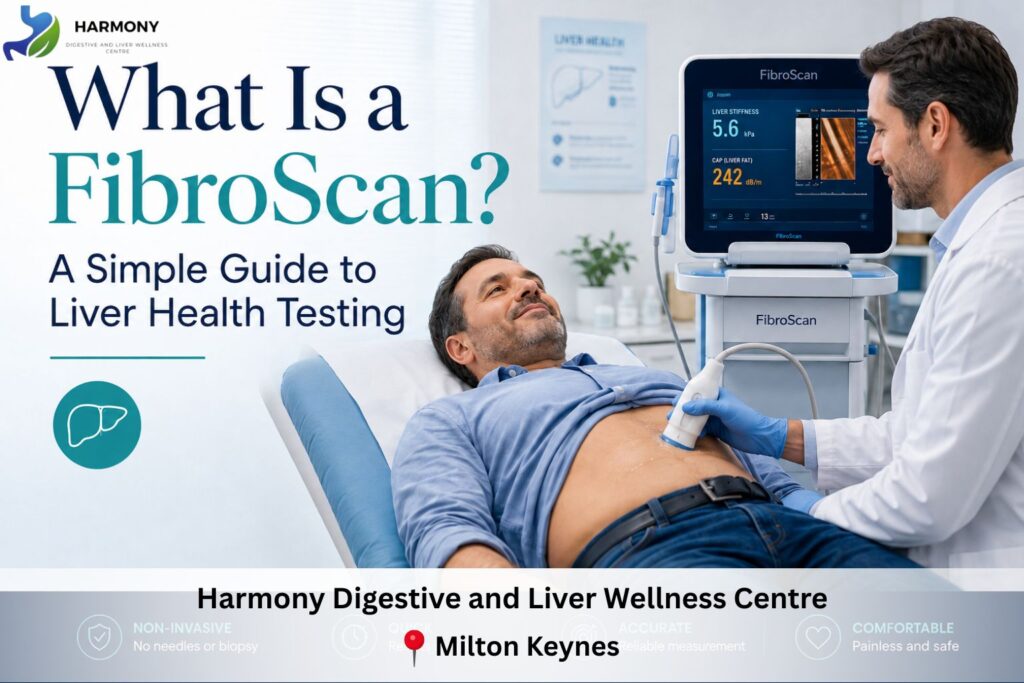
You’ve been told your liver needs a closer look. Maybe your blood tests came back slightly off. Maybe an ultrasound mentioned fat. Your doctor has said the word “FibroScan,” and now you’re wondering What is a FibroScan? I’m Dr. Arjun Prakash, a Consultant Gastroenterologist. FibroScan is one of the most valuable tools I use to assess liver health and one of the least understood by patients who need it most. Here’s what you should know. The Old Way of Doing Things For years, the only reliable way to assess liver damage was a biopsy, a needle, a tissue sample, a recovery period, and real risk. Most patients avoided it unless the situation was already serious. That meant a lot of quiet, undetected progression. Liver scarring while everyone waits for symptoms that often don’t arrive until it’s too late. FibroScan changed that entirely. What is a Fibroscan and What It Actually Does A single, painless session that tells you crucial things about your liver health: Measures how much fat has built up in your liver Measures how stiff or scarred your liver tissue has become Works by sending a gentle vibration through the skin and tracking how fast it travels through liver tissue. The stiffer the liver, the faster the wave A computer converts the reading into a precise numerical result No needle. No sedation. No recovery time. What to Expect What is a FibroScan? It is a quick, painless, and non-invasive liver test that helps check liver fat and stiffness. The whole process takes ten to fifteen minutes. You’ll lie on your back, arm raised, while a small probe is pressed gently between your ribs. You’ll feel a mild flicking sensation repeated around ten times. That’s it. Results are available immediately, with no waiting days for a lab report. We can discuss your numbers in the same appointment. One practical note: you’ll be asked to fast for two to three hours beforehand, as a full stomach affects the readings. Is a FibroScan the Same as a Liver Biopsy? Not at all, and for most patients, a FibroScan is now preferred precisely because it avoids the need for a biopsy. A liver biopsy requires a needle to take a small sample of liver tissue, which carries risks and requires recovery time. A FibroScan provides reliable information about liver stiffness across the whole organ without any of that. That said, there are situations where a biopsy may still be needed; your doctor will always advise based on your individual case. Who Should Have One You don’t need symptoms to benefit often; those who feel completely fine are the ones who need it most. A FibroScan is worth considering if you have: Type 2 diabetes Raised liver enzymes on a blood test Fatty liver was identified on a previous scan Obesity or high triglycerides A history of regular alcohol use A family history of liver disease Why It Matters Liver fibrosis is silent in its early stages. By the time patients feel unwell, the condition is often advanced. What makes this particularly frustrating is that early fibrosis is treatable. Cirrhosis is not. The difference between catching it at stage one and stage three isn’t just medical. It can be the difference between a lifestyle change and a transplant waitlist. FibroScan gives us the ability to find problems before they become permanent. I’ve seen early-stage numbers improve with the right intervention. The window exists but only if you use it. A Final Word At Harmony Digestive and Liver Wellness, we offer FibroScan alongside blood panels and ultrasound, giving you a complete liver picture explained in plain language, all under one roof. What is a FibroScan? It is a quick, painless, and non-invasive liver test that helps assess liver fat and stiffness without needles or recovery time. Book your consultation here. Your liver has been working quietly for you your whole life. Fifteen minutes to check on it is a fair return. Book a consultation or screening today: Click Here. To book a private liver or gut consultation or second opinion, Get in touch with us. Had a great experience with us? We’d love to hear your thoughts! Click here to leave a Google review.
Signs of Fatty Liver: When should you worry?”
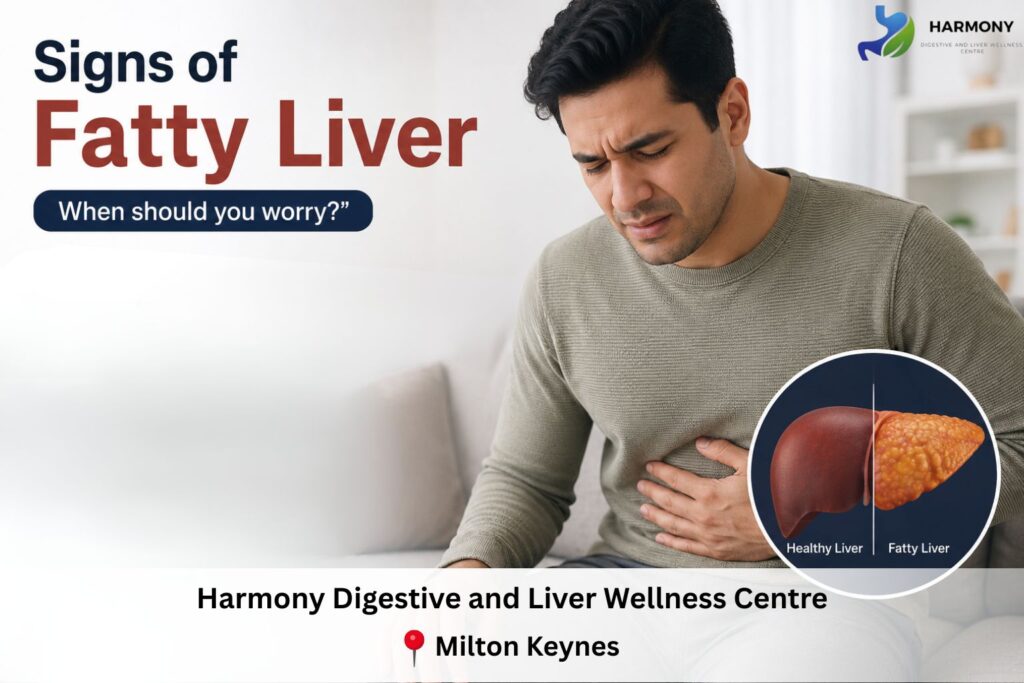
Your blood test comes back. Everything looks fine — except a small note about your liver enzymes. Your GP mentions “a bit of fat on the liver” and tells you not to worry. So you don’t. Until years later, you wish you had noticed the early signs of fatty liver disease. I’m Dr. Prakash Gupta, a Consultant Gastroenterologist. Fatty liver is one of the most common conditions I see — and one of the most misunderstood. Here’s what you actually need to know. What Fatty Liver Really Means Fatty liver (hepatic steatosis) is exactly what it sounds like: excess fat stored inside liver cells. The two main types are alcohol-related and non-alcohol-related (NAFLD/MASLD). The non-alcoholic form is now far more common, driven by obesity, type 2 diabetes, high cholesterol, and metabolic syndrome. And no — it’s not just a middle-aged problem. I see it in patients in their twenties. Why It’s So Easy to Miss When patients ask me about the signs of fatty liver, I tell them the honest truth: in the early stages, there are none. Your liver is quietly accumulating fat, and your body gives you no warning. That’s why most cases are discovered by accident — on a routine blood test or scan. Two common ways it shows up: a liver function test showing raised enzymes, or an abdominal ultrasound picking up a fatty appearance. If you have diabetes, are overweight, or have high triglycerides, don’t wait for symptoms — get checked. Subtle Signs Worth Paying Attention To When fatty liver does cause symptoms, they’re vague enough to be brushed off. Watch for: Persistent fatigue — heavier and more constant than ordinary tiredness. Dull discomfort under the right ribs — a feeling of fullness or pressure, not a sharp pain. Difficulty losing weight despite diet and exercise — a sign your metabolism may be struggling. Brain fog or low mood — increasingly recognised in patients with MASLD. Any one of these on its own isn’t a diagnosis. Combined with risk factors, they’re worth a conversation. When to Take It Seriously — Fast These signs of fatty liver suggest the condition has progressed to inflammation or fibrosis, and need urgent specialist review: Yellowing of the skin or eyes (jaundice) Swelling in the legs or abdomen (ascites) Easy bruising or bleeding Confusion or trouble concentrating How We Actually Investigate It A standard workup begins with blood tests for liver enzymes and metabolic markers, plus an ultrasound. But the most important tool I rely on is elastography (commonly referred to as FibroScan) — a quick, non-invasive scan that does two things in one visit: it measures how much fat is in your liver and how much scarring (fibrosis) is present. It takes minutes, there’s no needle, and it gives us a precise picture of where you stand — information that previously required a liver biopsy. The Good News Caught early, fatty liver is reversible. Genuinely reversible. With the right changes — and sometimes medication — patients I see routinely bring their liver back to a healthy state. Left alone, it can progress to cirrhosis, which is not reversible. The window matters. When to See a Specialist If you’re unsure whether you’re experiencing signs of fatty liver, book an appointment if any of the following apply: Your blood tests show raised liver enzymes An ultrasound mentioned a fatty or enlarged liver You have diabetes, high cholesterol, or are carrying excess weight You’re experiencing any of the red-flag symptoms above A Final Word At Harmony Digestive and Liver Wellness, we help you identify the early signs of fatty liver disease with a complete liver investigation — including blood panels, ultrasound, and elastography (FibroScan) — all under one roof, with results explained in plain English. Book a consultation or screening today: Click Here. To book a private liver or gut consultation or second opinion, Get in touch with us. Had a great experience with us? We’d love to hear your thoughts! Click here to leave a Google review.
Abnormal Liver Test and Liver Health: Know from Expert
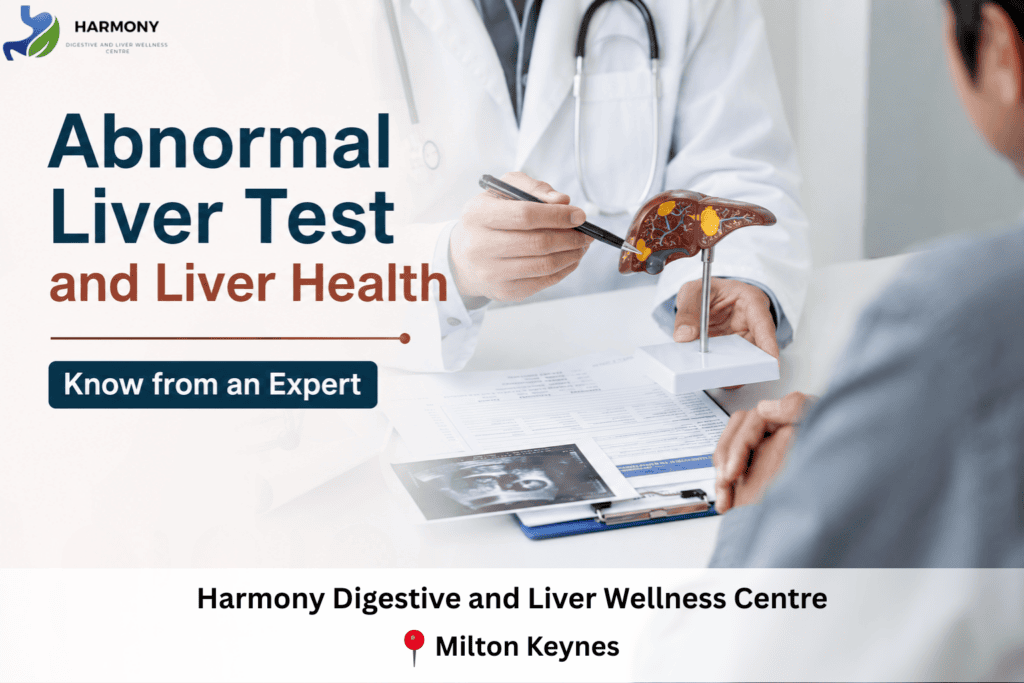
I am Dr. Arjun Prakash, a Consultant Gastroenterologist specializing in liver diseases. A frequent reason for patients presenting in an anxious manner to my clinic over the years has been a letter or message from their GP with a liver blood test result, e.g., “Your liver blood tests have come back slightly abnormal.” That is enough to send people into a spiral. Let me show you what it means, what I see in clinical practice, and when you actually have to take action. What Does an Abnormal Liver Test Actually Mean? Liver function test (LFT) is a simple test of the blood that looks for the amount of various enzymes and proteins that the liver produces (such as ALT, AST, bilirubin, alkaline phosphatase, albumin). The return of any of these outside the normal range is indicated as an abnormal liver test. But, this rings a bell with me that I give to all my patients: If the test comes back abnormal, it is not a diagnosis. It’s a cue that must be understood in the context. A mild elevation of ALT, for example, may be due to a few weeks of overindulgence in food and fluids, a recently prescribed medication, or even to strenuous exercise immediately prior to the test. However, if the results are frequently outside the normal range, this should never be ignored. The Patients I See Most Often I see a true cross-section in my clinic of people who have abnormal liver test results. Here are a couple of typical patterns: The “routine check-up surprise” A patient visits for a general check-up, usually prior to initiating a new drug, and their liver enzymes are elevated. They don’t experience any symptoms at all. This is the stage where early fatty liver disease is frequently detected. The long-term medication user Some drugs, such as long-term medication users and some antibiotics and anti-epileptics, can alter liver enzymes with time. When I see an abnormal liver test, I always look at the patient’s medication list very closely. The ‘I just wasn’t feeling right’ patient Sometimes, people present with some vague tiredness, a little discomfort in the upper abdomen, or with nausea; then a blood test shows that the liver is under stress. These patients typically develop liver disease at an early stage, where we can make an impact. Common causes of abnormal liver tests include: In practice, I encounter several of these types of situations quite frequently: Non alcoholic fatty liver disease (NAFLD): This is one of the most common conditions I see and one that I see more in patients who have obesity, type 2 diabetes, and metabolic syndrome. Alcohol-related liver injury (not necessarily heavy drinkers): Liver enzymes can even become elevated with moderate alcohol consumption and other risk factors. Viral hepatitis (B or C):Occasionally, found during a routine test. Autoimmune liver disease:these are not usually obvious and often are not picked up by a specialist assessment. Injury from medications/supplements: including herbs, which patients often don’t report unless prompted. What I Do Next: The Specialist Workup If a patient is presenting with the same abnormal liver tests for several months, I am not going to repeat the same blood test. I built a picture. The first thing I do is take a detailed history, alcohol, meds, family history, BMI, and symptoms. Next, I usually order other specific blood tests and, often, an ultrasound of the liver to inspect the liver’s architecture. I will make a FibroScan, a non-invasive test that assesses liver stiffness, in many cases, particularly if fatty liver or early liver fibrosis is suspected, which will provide a much better indication of whether or not scarring is present. This staged, thorough approach means we get to the right answer faster and, more importantly, patients leave, knowing exactly what’s going on, not just that “something is off.” Can an Abnormal Liver Test Be Reversed? This is probably the question I get asked most. And the truth is, it depends on the cause, but in many cases, yes. When the abnormal liver test is related to lifestyle (diet, alcohol, weight), the liver can get well again with a change in lifestyle. I’ve seen patients with really high enzymes come down to normal ranges with diet and weight loss alone in three to six months. In cases where liver disease is caused by viral hepatitis, autoimmune disease, or advanced fibrosis, the treatment is more specific and requires specialist management. Early referral is where it comes into play. A Final Word An abnormal liver test does not necessarily indicate liver failure. What this means is that your liver is talking to you. My role, and my team’s role, is to listen carefully, investigate thoroughly, and ensure clarity about what’s happening and what needs to be done. Book Your Consultation! The liver is resilient, but it does best when you don’t ignore the warning signs. Book a consultation or screening today: Click Here. To book a private liver or gut consultation or second opinion, Get in touch with us. Had a great experience with us? We’d love to hear your thoughts! Click here to leave a Google review.
Symptoms of Small Intestinal Bacterial Overgrowth You Should Know
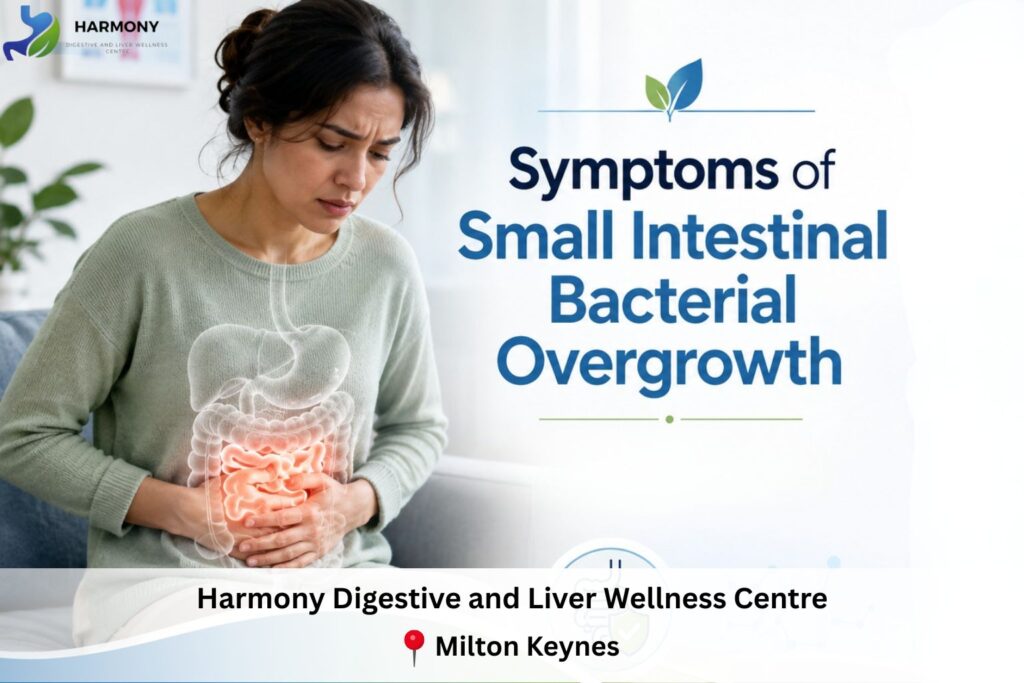
Many people face stomach discomfort but ignore it. You may feel gas, bloating or pain after eating. Sometimes this happens often. One possible reason is a condition called small intestinal bacterial overgrowth. It is important to know the symptoms of small intestinal bacterial overgrowth to understand your body better. Your small intestine should have limited bacteria present in it. When too many bacteria grow there, digestion gets affected. This results in discomfort and other health issues. What is Small Intestinal Bacterial Overgrowth? Small intestinal bacterial overgrowth also called SIBO. It happens when bacteria increase in the small intestine. This bacteria starts to affect digestion. They break food in the wrong way which creates gas. This can also lead to many uncomfortable symptoms. It is a common but often ignored condition. Common Symptoms of SIBO There are many symptoms of small intestinal bacterial overgrowth. They may look normal at first. When you have bloating after meals Gas and discomfort Stomach pain or cramps Diarrhea or constipation Feeling full very quickly All these symptoms may come and go. But if they continue to happen, they should not be ignored. Other Signs of SIBO Some symptoms are less common but still important. Having bad breath Weakness or low energy Weight loss without any reason Nutrient deficiency These signs show that your body is not absorbing nutrients properly. Why Does It Happen? This condition can happen due to many different reasons. Slow digestion can make the bacteria stay longer in the intestine. Poor diet and stress also affect the working and health of your gut. Certain medical conditions can also increase the risk. When digestion is not smooth, bacteria can grow more than normal. How It Affects Your Daily Life The symptoms of small intestinal bacterial overgrowth can disturb your day to day life. It can make you feel uncomfortable after eating. You may need to avoid eating certain foods. You may feel tired the whole day without even doing any work. It can also affect your mood and energy levels. When to Take It Seriously If your symptoms stay for a long time, it is important to take action. Do not ignore regular bloating or stomach pain. These may be signs of a serious issue. Early care can help you avoid bigger problems later. Treatment of SIBO Doctors may suggest tests to confirm SIBO. These tests help to find the right cause of your symptoms. Treatment include medicines and diet changes. It helps to reduce the bacteria and improve digestion. Proper care helps you recover faster. Proper Treatment and Care It is important to get the correct treatment. Harmony Digestive and Liver Wellness Centre provides proper care for digestive problems. They work on finding the root cause of your problem. They focus on improving your gut health and providing you comfort. How to Support Gut Health Along with treatment, small lifestyle changes can help. Eat light and simple meals Avoid heavy and oily food Drink enough water Manage stress Eat on time These steps support better digestion. Conclusion – Gut Health Specialist Understanding the Symptoms of Small Intestinal Bacterial Overgrowth is important for your health. Early signs may look simple but should not be ignored. Harmony Digestive and Liver Wellness Centre, can help you manage this condition and improve your digestive health. A healthy gut helps you feel comfortable and active every day. Book a consultation or screening today: Click Here. To book a private liver or gut consultation or second opinion, Get in touch with us. Had a great experience with us? We’d love to hear your thoughts! Click here to leave a Google review.