 Skip to main content

Does IBS Cause Bloating? When is it IBS and when should it be investigated?
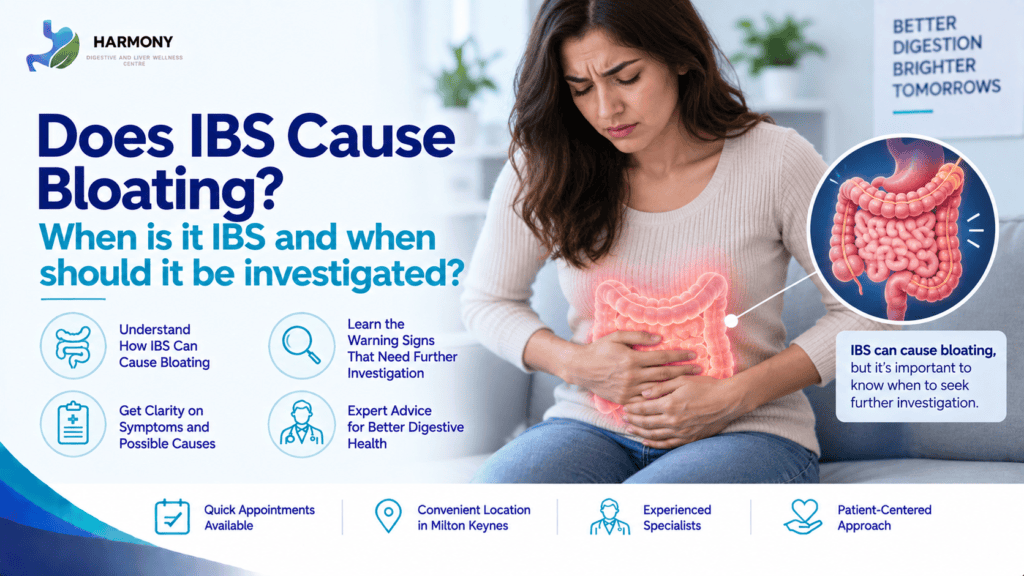
Bloating gets blamed on everything. Too much bread. Eating too fast. A stressful week. And sometimes, that’s exactly what it is. But when it keeps coming back – week after week, meal after meal – it deserves a more careful answer. Does IBS cause bloating? Yes, it does. IBS is known to cause bloating, often in the form of fullness, pressure, or visible distension.
I’m Dr Arjun Prakash, a Consultant Gastroenterologist. If you’ve been living with persistent bloating and told there’s nothing to investigate, this is worth reading. Because the answer isn’t always IBS – and even when it is, IBS deserves better than a label with no plan behind it.
What Is IBS – and Does IBS Cause Bloating?
Irritable bowel syndrome is a functional gut condition – meaning the bowel looks structurally normal, but behaves abnormally. The gut becomes hypersensitive, reacting disproportionately to ordinary amounts of gas, food, or movement. The result is a pattern of symptoms: abdominal discomfort, unpredictable bowel habits, and yes – bloating.
So does IBS cause bloating? It does. Patients describe it as fullness, pressure, or visible distension – often building through the day and worsening around meals or periods of stress.
But here’s what matters clinically: IBS is a diagnosis of exclusion. Before that label is applied, other causes need to be confidently ruled out. Bloating is equally a feature of coeliac disease, small intestinal bacterial overgrowth (SIBO), inflammatory bowel disease, ovarian conditions, and – in cases that cannot be missed – early gastrointestinal malignancy.
What IBS Bloating Actually Feels Like
IBS-related bloating tends to follow a recognisable pattern. It:
- Fluctuates – better some days, worse on others
- Worsens after eating, particularly foods high in fermentable carbohydrates (FODMAPs)
- Is linked to a change in bowel habit – either loose stools, constipation, or alternating between the two
- Improves, at least partially, after opening the bowels
- Tracks closely with stress, anxiety, or disrupted sleep
A diagnosis of IBS should never be the end of the conversation. It should be the beginning of one – with a clear management plan, not just a name for what you’re experiencing.
When Bloating Needs More Than Reassurance
This is where I ask patients to pay close attention. Certain features alongside bloating suggest the gut needs investigating beyond a clinical consultation alone:
- Unintentional weight loss – even a few kilograms over a few months
- Rectal bleeding or blood mixed into stools
- Bloating that is constant rather than fluctuating – a distension that doesn’t ease overnight
- New bloating in someone over 50 with no prior gut history
- Waking at night with abdominal discomfort
- A family history of bowel cancer, ovarian cancer, or inflammatory bowel disease
Any one of these changes the conversation. These aren’t IBS features. They’re red flags – and they warrant urgent specialist review.
How We Actually Investigate It
A thorough workup for persistent bloating starts with blood tests: inflammatory markers, coeliac antibodies, thyroid function, and a full blood count. Stool calprotectin tests can distinguish functional gut symptoms from active inflammation with high accuracy.
Depending on findings, the investigation may extend to a colonoscopy, a hydrogen breath test for SIBO, or cross-sectional imaging. The right pathway depends on the full clinical picture – which is why a specialist consultation is the most efficient route to answers.
A Final Word
Does IBS cause bloating? Yes. But bloating causing you concern deserves more than a label. It deserves a clear diagnosis, a proper exclusion of other causes, and a management plan that actually works.
If your bloating is persistent, worsening, or comes with any of the red-flag features above, don’t wait it out.
At Harmony Digestive and Liver Wellness, we offer a complete gut assessment – from blood and stool tests to endoscopy and specialist review – with every result explained clearly. Book your consultation here.
Book a consultation or screening today: Click Here.
To book a private liver or gut consultation or second opinion, Get in touch with us.
Had a great experience with us? We’d love to hear your thoughts! Click here to leave a Google review.