

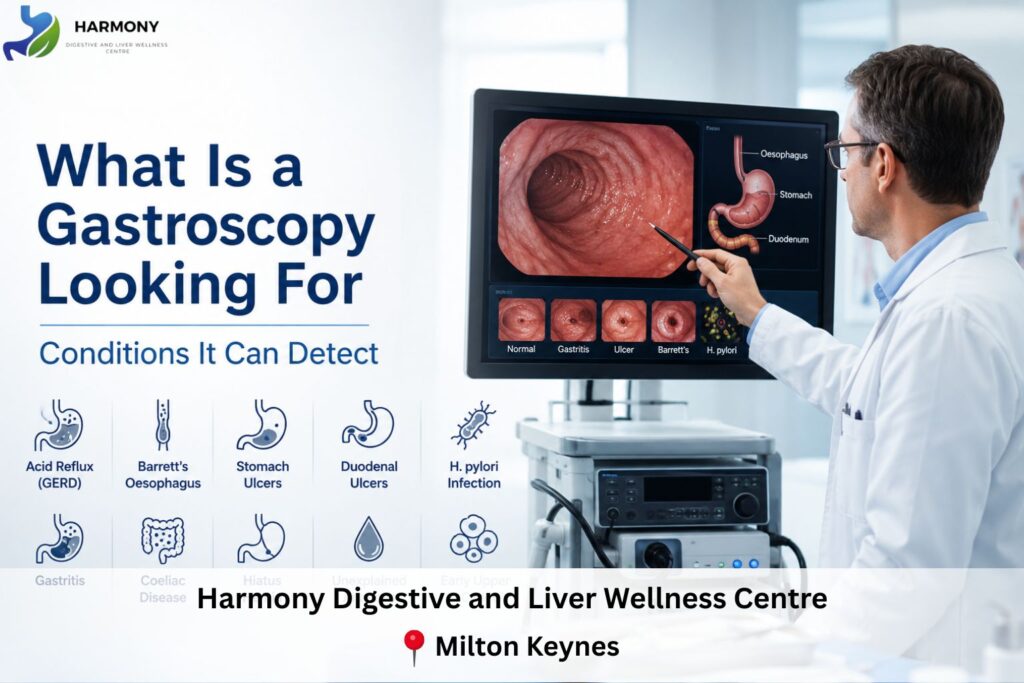
Some symptoms just won’t let you ignore them. A burning feeling after most meals. Trouble swallowing food you’ve eaten your whole life. Nausea that shows up without warning. You get blood tests done, and everything comes back normal. And yet something still feels off. This is when many people start asking, “What Is a Gastroscopy Looking For?” because it can help doctors examine the upper digestive tract more closely.
I’m Dr Prakash Gupta, Consultant Gastroenterologist. I hear this from patients regularly. Normal tests, real symptoms, no answers. And in many of those cases, what finally gave us the answer was a gastroscopy – a direct look at what’s actually going on inside.”
What Is a Gastroscopy Looking For?
A gastroscopy – sometimes called an upper endoscopy or OGD – passes a thin, flexible camera through the mouth to examine the oesophagus, stomach, and duodenum (the first section of the small intestine). It takes around 10 to 15 minutes.
So, what is a gastroscopy looking for? The answer is: things blood tests and scans simply cannot show. The lining of your gut, changes in tissue, signs of infection, early damage – all of it visible in real time.
Conditions It Can Detect
Acid Reflux and GORD:
Heartburn is the most common reason patients come to me for an upper GI review. A gastroscopy tells us whether your oesophagus lining has actually been damaged – and how badly. Symptoms alone can’t give us that.
Barrett’s Oesophagus:
With long-term acid exposure, the oesophagus lining can change in ways that raise the risk of cancer if left unmonitored. Most people with Barrett’s feel completely normal. That’s precisely why it gets missed.
Stomach and Duodenal Ulcers:
Ulcers can bleed quietly for a long time before causing obvious pain. A gastroscopy finds them, lets us take biopsies, and in some cases treats bleeding on the spot. If your stomach pain wakes you at night, book a consultation – don’t keep waiting.
H. pylori Infection:
Pylori bacterial infection sits behind many cases of gastritis, ulcers, and – over years – an elevated risk of stomach cancer. We test for it directly by taking small tissue samples during the procedure.
Gastritis:
Inflammation of the stomach lining rarely shows on blood tests. But it shows clearly on gastroscopy. If you’ve been told your results are normal while symptoms carry on, this is often the finding people have been waiting for.
Coeliac Disease:
Small biopsies taken from the duodenum can confirm coeliac disease – a condition that goes undiagnosed in far too many people for far too long. Years of bloating, tiredness, and gut trouble, all with a treatable cause sitting quietly underneath.
Oesophageal and Stomach Cancer:
Early upper GI cancers frequently produce no symptoms, or symptoms that get attributed to something else. Found early, outcomes are considerably better. Unexplained weight loss, food sticking when you swallow, or persistent vomiting – these need investigation.
Hiatus Hernia:
When part of the stomach pushes through the diaphragm, it can drive reflux symptoms that just don’t respond to standard medication. Gastroscopy confirms it clearly and changes the treatment approach.
Unexplained Anaemia:
A slowly falling blood count with no obvious cause often points to silent bleeding somewhere in the upper GI tract. Gastroscopy finds the source.
The Right Test for the Right Answer
By the time most patients reach Harmony Digestive and Liver Wellness, they’ve already been through the standard tests. Normal results, still symptomatic, no real explanation. What Is a Gastroscopy Looking For? A gastroscopy doesn’t replace those tests – it goes further. It shows us the actual lining of your gut. That’s information blood work simply can’t give.
You’re not being overly cautious by wanting a proper answer. You’re being sensible. If your gut is telling you something, it’s worth listening to. Book your gastroscopy assessment today.
Book a consultation or screening today: Click Here.
To book a private liver or gut consultation or second opinion, Get in touch with us.
Had a great experience with us? We’d love to hear your thoughts! Click here to leave a Google review.