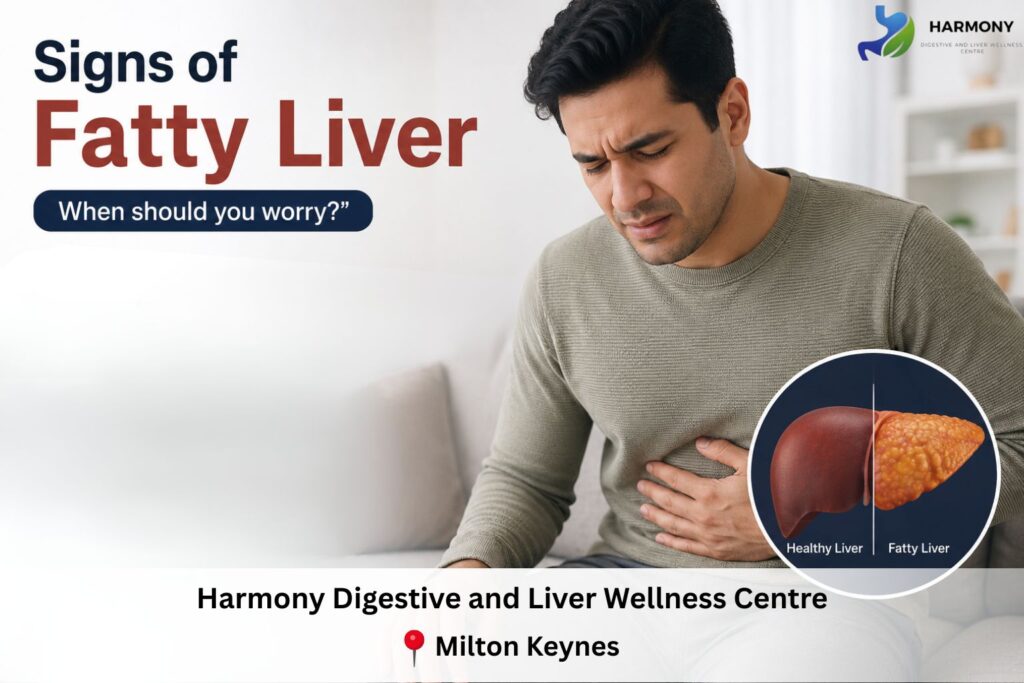
Your blood test comes back. Everything looks fine — except a small note about your liver enzymes. Your GP mentions “a bit of fat on the liver” and tells you not to worry. So you don’t. Until years later, you wish you had noticed the early signs of fatty liver disease.
I’m Dr. Prakash Gupta, a Consultant Gastroenterologist. Fatty liver is one of the most common conditions I see — and one of the most misunderstood. Here’s what you actually need to know.
What Fatty Liver Really Means
Fatty liver (hepatic steatosis) is exactly what it sounds like: excess fat stored inside liver cells. The two main types are alcohol-related and non-alcohol-related (NAFLD/MASLD). The non-alcoholic form is now far more common, driven by obesity, type 2 diabetes, high cholesterol, and metabolic syndrome.
And no — it’s not just a middle-aged problem. I see it in patients in their twenties.
Why It’s So Easy to Miss
When patients ask me about the signs of fatty liver, I tell them the honest truth: in the early stages, there are none. Your liver is quietly accumulating fat, and your body gives you no warning. That’s why most cases are discovered by accident — on a routine blood test or scan.
Two common ways it shows up: a liver function test showing raised enzymes, or an abdominal ultrasound picking up a fatty appearance. If you have diabetes, are overweight, or have high triglycerides, don’t wait for symptoms — get checked.
Subtle Signs Worth Paying Attention To
When fatty liver does cause symptoms, they’re vague enough to be brushed off. Watch for:
- Persistent fatigue — heavier and more constant than ordinary tiredness.
- Dull discomfort under the right ribs — a feeling of fullness or pressure, not a sharp pain.
- Difficulty losing weight despite diet and exercise — a sign your metabolism may be struggling.
- Brain fog or low mood — increasingly recognised in patients with MASLD.
Any one of these on its own isn’t a diagnosis. Combined with risk factors, they’re worth a conversation.
When to Take It Seriously — Fast
These signs of fatty liver suggest the condition has progressed to inflammation or fibrosis, and need urgent specialist review:
- Yellowing of the skin or eyes (jaundice)
- Swelling in the legs or abdomen (ascites)
- Easy bruising or bleeding
- Confusion or trouble concentrating
How We Actually Investigate It
A standard workup begins with blood tests for liver enzymes and metabolic markers, plus an ultrasound. But the most important tool I rely on is elastography (commonly referred to as FibroScan) — a quick, non-invasive scan that does two things in one visit: it measures how much fat is in your liver and how much scarring (fibrosis) is present. It takes minutes, there’s no needle, and it gives us a precise picture of where you stand — information that previously required a liver biopsy.
The Good News
Caught early, fatty liver is reversible. Genuinely reversible. With the right changes — and sometimes medication — patients I see routinely bring their liver back to a healthy state. Left alone, it can progress to cirrhosis, which is not reversible. The window matters.
When to See a Specialist
If you’re unsure whether you’re experiencing signs of fatty liver, book an appointment if any of the following apply:
- Your blood tests show raised liver enzymes
- An ultrasound mentioned a fatty or enlarged liver
- You have diabetes, high cholesterol, or are carrying excess weight
- You’re experiencing any of the red-flag symptoms above
A Final Word
At Harmony Digestive and Liver Wellness, we help you identify the early signs of fatty liver disease with a complete liver investigation — including blood panels, ultrasound, and elastography (FibroScan) — all under one roof, with results explained in plain English.
Book a consultation or screening today: Click Here.
To book a private liver or gut consultation or second opinion, Get in touch with us.
Had a great experience with us? We’d love to hear your thoughts! Click here to leave a Google review.