
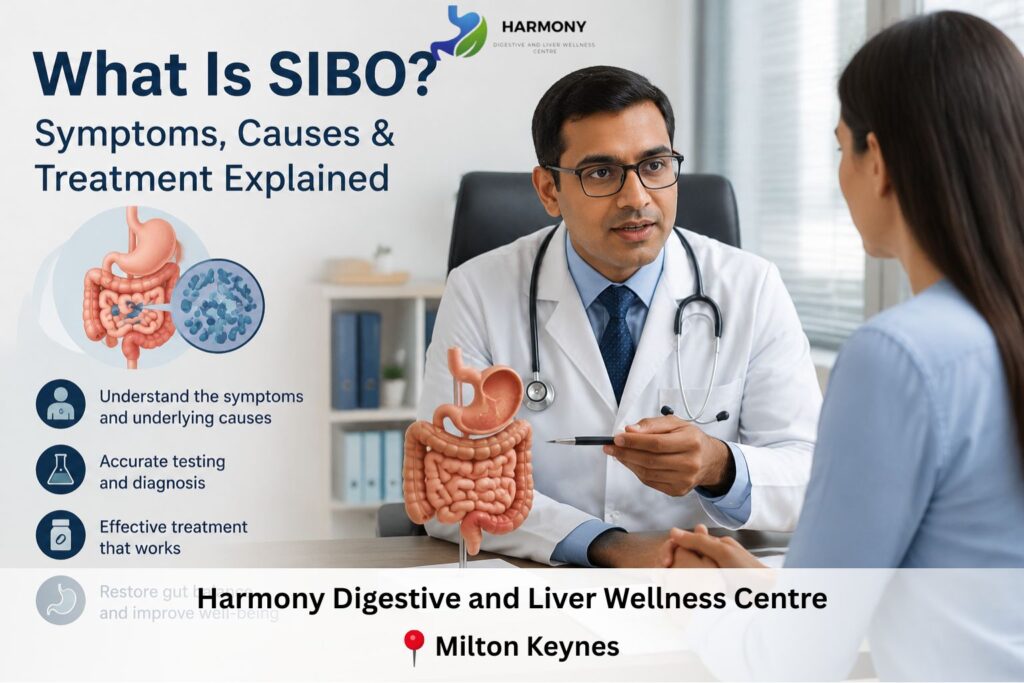
If you’ve been bloated after every meal, dealing with unpredictable bowel habits, and getting nowhere despite cutting out food after food, there’s a condition most people haven’t heard of that could explain everything. It’s called SIBO: Small Intestinal Bacterial Overgrowth. It’s underdiagnosed, frequently mistaken for IBS, and in most cases, very treatable. The problem is simply getting to the right diagnosis.
I’m Dr Prakash Gupta, a Consultant Gastroenterologist. SIBO is underdiagnosed, frequently misattributed to IBS, and in most cases, very treatable. The problem is simply getting to the right diagnosis.
What Exactly Is SIBO?
Your digestive system hosts trillions of bacteria — mostly beneficial, but location matters. Your large intestine is built to handle high bacterial populations. Your small intestine is not.
SIBO occurs when bacteria migrate upward and colonise the small intestine in numbers it can’t manage. Once there, they ferment your food before your body absorbs it properly — producing excess gas, inflammation, and a gut that feels permanently off. This isn’t a traditional infection. It’s the wrong organisms in the wrong place.
Symptoms of SIBO: What to Look For
SIBO doesn’t tend to announce itself with one dramatic symptom. It’s usually a cluster of things that have been building for months — sometimes years. The most common ones I see:
- Persistent bloating, particularly after meals — often described as a ‘balloon’ sensation that builds throughout the day
- Abdominal discomfort, cramping, or a general sense of pressure in the gut
- Unpredictable bowel habits — this can mean constipation, loose stools, or both alternating
- Excessive gas and flatulence that seems out of proportion to what you’ve eaten
- Unexplained fatigue — when your gut isn’t absorbing nutrients efficiently, the rest of your body feels it
- In longer-standing cases: deficiencies in B12, iron, or fat-soluble vitamins (A, D, E, K)
You may find that certain foods — particularly those containing onions, garlic, legumes, or wheat — seem to make things significantly worse. This is because these foods are rapidly fermented by bacteria, and in SIBO, there are far too many bacteria to manage that fermentation process properly.
What Causes SIBO?
In most cases, SIBO develops because something has disrupted the small intestine’s ability to keep bacteria moving through and prevent them from settling in.
A few of the most common underlying mechanisms:
- Sluggish gut motility — The small intestine uses rhythmic contractions (the migrating motor complex) to sweep bacteria forward. When this slows — common in diabetes, thyroid conditions, or after abdominal surgery — bacteria accumulate.
- Low stomach acid — Acid is a frontline defence against bacterial overgrowth. Long-term use of PPIs like omeprazole quietly erodes that protection without most people realising.
- Structural changes — Surgical adhesions or strictures create stagnant zones were bacteria multiply unchallenged.
- Post-infectious damage — A single serious bout of food poisoning or gastroenteritis can permanently alter gut motility, leaving the small intestine sluggish and vulnerable long after recovery.
Treatment: What Actually Works
A simple hydrogen and methane breath test — no needles, no hospital. You fast overnight, drink a sugar solution, and breathe into tubes for over two hours. Elevated gas readings confirm overgrowth.
Treatment:
- Rifaximin is the first-line antibiotic — works directly inside the gut, barely enters the bloodstream
- Minimal side effects compared to standard antibiotics
- Most patients notice real improvement within two weeks
- For methane-dominant SIBO, a second antibiotic is often added for better results
- The root cause must be addressed — motility, acid suppression, or structural issues — or SIBO returns
- A low-FODMAP diet runs alongside antibiotics to reduce foods that feed bacterial fermentation
- Low-FODMAP is short-term only — not a permanent diet, but genuinely helpful during recovery
- Full symptom resolution typically happens within a month of completing treatment
A Final Word
If you’ve had ongoing digestive symptoms, a normal colonoscopy, and no clear diagnosis — that’s the pattern that should prompt a SIBO conversation.
You don’t need to have every symptom on the list. If bloating after meals, unpredictable bowel habits, and persistent gut discomfort have been part of your life for more than a few months — especially if standard investigations haven’t given you answers — it’s time to look further.
At Harmony Digestive and Liver Wellness, we offer breath testing and thorough gut investigations, with findings explained in plain language.
Book a consultation or screening today: Click Here.
To book a private liver or gut consultation or second opinion, Get in touch with us.
Had a great experience with us? We’d love to hear your thoughts! Click here to leave a Google review.