
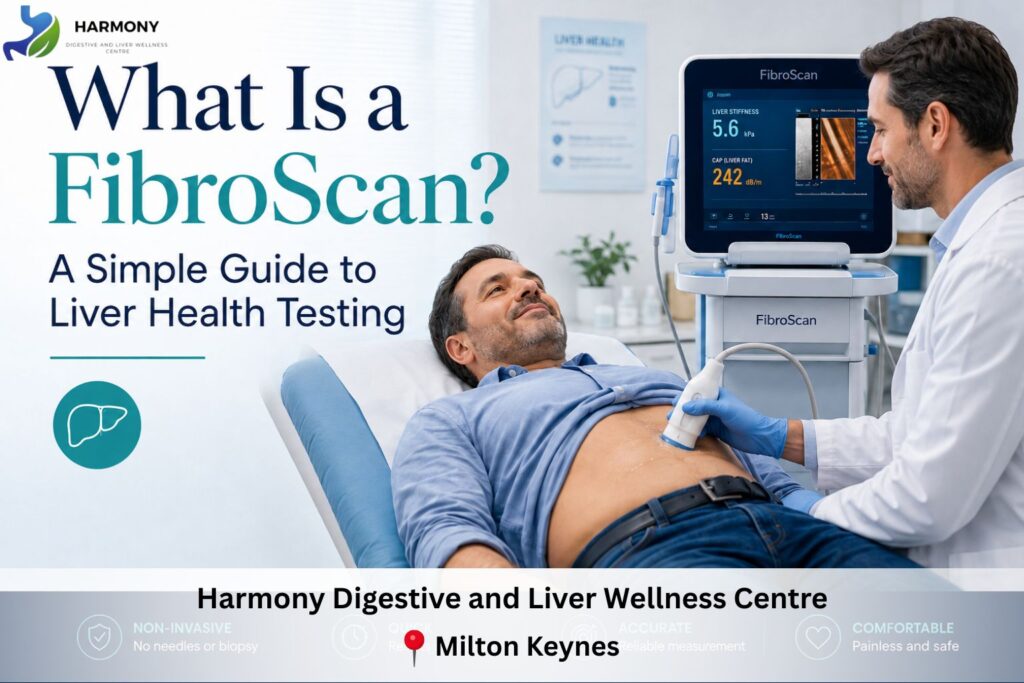
You’ve been told your liver needs a closer look. Maybe your blood tests came back slightly off. Maybe an ultrasound mentioned fat. Your doctor has said the word “FibroScan,” and now you’re wondering What is a FibroScan?
I’m Dr. Arjun Prakash, a Consultant Gastroenterologist. FibroScan is one of the most valuable tools I use to assess liver health and one of the least understood by patients who need it most. Here’s what you should know.
The Old Way of Doing Things
For years, the only reliable way to assess liver damage was a biopsy, a needle, a tissue sample, a recovery period, and real risk. Most patients avoided it unless the situation was already serious. That meant a lot of quiet, undetected progression. Liver scarring while everyone waits for symptoms that often don’t arrive until it’s too late.
FibroScan changed that entirely.
What is a Fibroscan and What It Actually Does
A single, painless session that tells you crucial things about your liver health:
- Measures how much fat has built up in your liver
- Measures how stiff or scarred your liver tissue has become
- Works by sending a gentle vibration through the skin and tracking how fast it travels through liver tissue. The stiffer the liver, the faster the wave
- A computer converts the reading into a precise numerical result
- No needle. No sedation. No recovery time.
What to Expect
What is a FibroScan? It is a quick, painless, and non-invasive liver test that helps check liver fat and stiffness. The whole process takes ten to fifteen minutes. You’ll lie on your back, arm raised, while a small probe is pressed gently between your ribs. You’ll feel a mild flicking sensation repeated around ten times. That’s it.
Results are available immediately, with no waiting days for a lab report. We can discuss your numbers in the same appointment. One practical note: you’ll be asked to fast for two to three hours beforehand, as a full stomach affects the readings.
Is a FibroScan the Same as a Liver Biopsy?
Not at all, and for most patients, a FibroScan is now preferred precisely because it avoids the need for a biopsy. A liver biopsy requires a needle to take a small sample of liver tissue, which carries risks and requires recovery time. A FibroScan provides reliable information about liver stiffness across the whole organ without any of that.
That said, there are situations where a biopsy may still be needed; your doctor will always advise based on your individual case.
Who Should Have One
You don’t need symptoms to benefit often; those who feel completely fine are the ones who need it most.
A FibroScan is worth considering if you have:
- Type 2 diabetes
- Raised liver enzymes on a blood test
- Fatty liver was identified on a previous scan
- Obesity or high triglycerides
- A history of regular alcohol use
- A family history of liver disease
Why It Matters
Liver fibrosis is silent in its early stages. By the time patients feel unwell, the condition is often advanced. What makes this particularly frustrating is that early fibrosis is treatable. Cirrhosis is not.
The difference between catching it at stage one and stage three isn’t just medical. It can be the difference between a lifestyle change and a transplant waitlist.
FibroScan gives us the ability to find problems before they become permanent. I’ve seen early-stage numbers improve with the right intervention. The window exists but only if you use it.
A Final Word
At Harmony Digestive and Liver Wellness, we offer FibroScan alongside blood panels and ultrasound, giving you a complete liver picture explained in plain language, all under one roof. What is a FibroScan? It is a quick, painless, and non-invasive liver test that helps assess liver fat and stiffness without needles or recovery time. Book your consultation here.
Your liver has been working quietly for you your whole life. Fifteen minutes to check on it is a fair return.
Book a consultation or screening today: Click Here.
To book a private liver or gut consultation or second opinion, Get in touch with us.
Had a great experience with us? We’d love to hear your thoughts! Click here to leave a Google review.