
You’ve probably heard both terms mentioned — FibroScan vs Ultrasound — and wondered whether they’re the same thing, or why your doctor might recommend one over the other. It’s a question I get asked a lot in the clinic.
I’m Dr Prakash Gupta, Consultant Gastroenterologist and Hepatologist at Harmony Digestive and Liver Wellness. Let me explain the difference in straightforward terms, because it genuinely matters for how we look after your liver.
What a Liver Ultrasound Actually Does
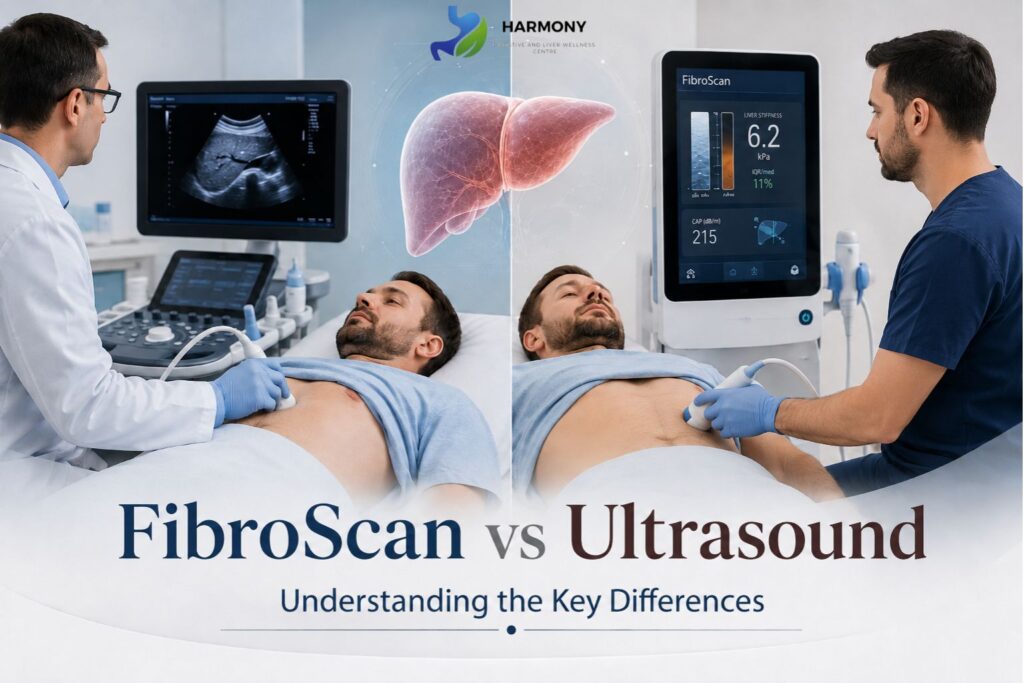
Most people have had an ultrasound at some point. It’s the same technology used in pregnancy scans — sound waves that bounce off tissue and create an image on screen. The liver gives us a visual overview of the organ.
A liver ultrasound is useful for spotting:
- Obvious fatty changes or an enlarged liver
- Gallstones and bile duct problems
- Liver cysts or masses
- Signs of structural abnormality
It’s a good starting point. If you’ve come in with abnormal liver blood tests or unexplained abdominal symptoms, an ultrasound is often the first thing I’ll arrange.
But here’s what most patients aren’t told: a standard ultrasound cannot measure scarring inside the liver. It can tell me your liver looks fatty, or slightly enlarged, or a little irregular — but it can’t tell me whether there’s significant fibrosis building up beneath the surface. And that, unfortunately, is often the thing that matters most.
What a FibroScan Does Differently
FibroScan — the medical term is transient elastography — was developed specifically to fill that gap. It measures how stiff the liver is. Stiffness and scarring go hand in hand: the more fibrosis that has built up over time, the stiffer the liver becomes.
The way it works is quite elegant. A small probe sits against your skin, just below the ribs on the right side. It sends a gentle vibration into the liver and measures how quickly that vibration travels through the tissue. A soft, healthy liver slows it down. A stiff, scarred liver lets it pass through faster. The machine converts that into a number — expressed in kilopascals — and that number tells us a great deal about where things stand.
Here’s what the experience is actually like for patients:
- The whole test takes around 10–15 minutes
- There are no needles and no sedation
- You just need to avoid eating for 2–3 hours beforehand
- Results are available straight away
- Most patients tell me they were surprised by how unremarkable it was
So Which One Do You Actually Need?
The honest answer is: it depends on what question we’re trying to answer.
A liver ultrasound is the right tool when:
- We want a structural overview of the liver and surrounding organs
- There’s a concern about gallstones, masses, or obvious fatty changes
- It’s a first-step investigation for new symptoms or raised blood tests
A FibroScan is the right tool when:
- We need to know how much scarring or fibrosis is actually present
- We want to stage liver disease and monitor whether it’s progressing
- The ultrasound has flagged something, and we need to understand it better
For many patients, both have a role. An ultrasound might be the first step, and FibroScan follows to stage whatever has been found. If you’re also dealing with digestive symptoms alongside your liver concerns — bloating, discomfort, changes in bowel habit — it’s worth reading about gut inflammation symptoms, because the two are sometimes connected.
Why This Distinction Actually Matters
Liver disease is, frustratingly, often silent. I see patients in the clinic who feel absolutely fine and are shocked to learn they have significant fibrosis. By the time symptoms show up — fatigue, jaundice, fluid retention — the liver can already be under considerable strain.
You may benefit from liver stiffness testing if you have:
- Fatty liver was identified on a previous ultrasound
- Raised liver enzymes or abnormal liver blood tests
- Type 2 diabetes or metabolic syndrome
- Significant or regular alcohol intake
- A history of hepatitis B or C
- Obesity or high cholesterol
- A family history of liver disease
Even if you feel entirely well, any of these risk factors is a good reason to get a clearer picture. Early fibrosis can often be stabilised or reversed. Once liver disease reaches an advanced stage, the options narrow significantly — and that shift can hinge on whether the problem was caught at the right time.
Thinking About Getting Assessed?
If you’ve been told you have a fatty liver, your liver enzymes have come back raised, or you simply want to understand your liver health properly, a specialist assessment is the right next step.
A Final Word
At Harmony Digestive and Liver Wellness, we offer liver FibroScan vs Ultrasound testing with full consultant-led interpretation of your results. Not just a number handed to you in a letter — a proper conversation about what it means and what, if anything, needs to happen next.
Book a consultation or screening today: Click Here.
To book a private liver or gut consultation or second opinion, Get in touch with us.
Had a great experience with us? We’d love to hear your thoughts! Click here to leave a Google review.