
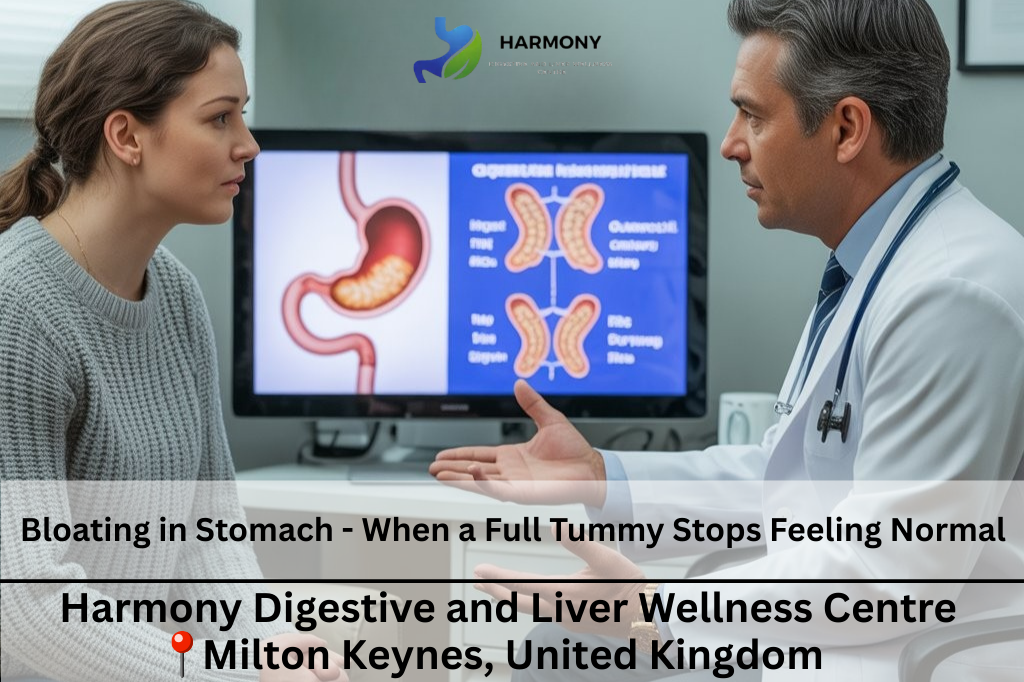
Most people recognise the feeling of being bloated after a big meal or a fizzy drink. That usually settles and life moves on.
What I see in clinic is more than that.
People describe waking up with a reasonably flat abdomen and, by late afternoon, feeling as if they are wearing a size smaller around the waist. Some talk about a constant internal pressure, others about sharp discomfort, gurgling and a sense of being “inflated” even when they are trying hard to eat sensibly.
If you are noticing this most days, it can start to affect what you wear, what you eat and what you feel able to plan. That is usually the point at which a more structured look at things becomes worthwhile.
My aim here is to explain how I think about bloating: what I listen for in the story, what I might investigate, how IBS and SIBO fit in, and how we can put together a plan that is realistic rather than extreme.
What "bloating" can actually mean
Different people mean different things by bloating, so I always ask you to describe it in your own words.
Some notice a clear increase in abdominal size as the day goes on, sometimes so marked that clothes feel tight or uncomfortable. Others feel a firm, pressurised sensation inside the abdomen, with relief after opening bowels or passing wind. For some, bloating comes with pain; for others, it is more of a dull heaviness.
The timing can be helpful. Bloating straight after meals, late in the day, overnight, or first thing in the morning all point in slightly different directions. So does the relationship to bowel habit – loose, constipated, alternating, or apparently normal.
Those details help to decide whether we are dealing with something like IBS, coeliac disease, SIBO, slow transit, functional bloating, or occasionally something more serious.
When is bloating worth investigating?
Short-lived bloating that eases with a bit of common sense around diet or portion size usually does not need specialist input.
I become more interested when:
- The bloating is present most days, for several weeks or months.
- You describe a clear change from how your abdomen used to feel.
- There is associated weight loss, blood in the stool, fever, night sweats or ongoing diarrhoea.
- Blood tests have shown low iron or anaemia.
- There is a strong family history of bowel disease or bowel cancer.
- You find yourself choosing clothes, routes and social plans around what your abdomen might do that day.
In those situations, it makes sense to move away from guessing and actually work out what is happening.
How I assess bloating in clinic
The starting point is always a detailed conversation.
I will usually ask:
- When you first noticed a change.
- Whether anything significant happened around that time (infection, travel, illness, surgery, a period of stress or major life change).
- How your bowels behave day to day.
- Whether you see mucus, blood, pale stool or very dark stool.
- How bloating relates to meals and certain foods.
- What you have already tried, and what helped or did not help.
From there, we can plan sensible investigations. These often include:
- Blood tests – including full blood count, iron studies, coeliac screening and basic biochemistry.
- Stool tests where appropriate – for inflammation and sometimes infection.
- Ultrasound or other imaging if examination or bloods suggest this.
- Endoscopy or colonoscopy when symptoms, age or risk factors make that appropriate.
The idea is not to order every test available, but to use the story and examination to choose investigations that are likely to change what we do next.
IBS, a sensitive gut and bloating
A large proportion of people with ongoing bloating eventually turn out to have irritable bowel syndrome (IBS) or another functional bowel disorder.
In IBS, the wiring of the gut is over-responsive. Normal amounts of gas and stretch, which most people barely notice, can feel uncomfortable or frankly painful. The bowel may speed up, slow down, or oscillate between the two. It often becomes harder to predict what your abdomen will do, which is exhausting in its own right.
I look after many people whose lives are constrained by this. They plan journeys around access to toilets, avoid trips, or feel they have to be “on guard” at work or socially because they do not quite trust their gut.
When IBS is the main driver, treatment aims to calm the system and restore some predictability. That usually means some combination of:
- Adjusting the type and amount of fibre rather than simply “eating more fibre”.
- Considering a short, structured low FODMAP trial with a dietitian, with a clear plan for reintroduction.
- Using medication to reduce cramping, ease pain, regulate bowel habit or address loose or constipated stool, depending on your pattern.
- Looking at sleep, stress, activity and simple pacing strategies in a way that fits your life rather than an idealised checklist.
Where SIBO breath testing comes in
SIBO (small intestinal bacterial overgrowth) is a genuine condition and an important part of the differential in some patients with bloating.
In SIBO, bacteria that are usually more concentrated in the large bowel become more prominent in the small bowel. Food is fermented earlier than it should be, which can produce gas, distension, discomfort and sometimes diarrhoea or nutritional issues.
I consider SIBO more actively when I see:
- Prominent upper abdominal bloating, often soon after eating.
- Excessive gas with discomfort rather than simple wind.
- Symptoms emerging after certain operations or illnesses that affect gut anatomy or motility.
- Bloating and diarrhoea that have not responded to well-judged IBS treatment.
- Specific patterns on bloods or imaging that raise suspicion.
The usual non-invasive way to investigate this is a breath test using glucose or lactulose. To be meaningful, the test needs a proper preparation protocol, timed samples and careful interpretation, otherwise the result quickly becomes more confusing than helpful.
At our gastroenterology clinic in central Milton Keynes, we offer validated SIBO breath testing using a standardised protocol. I do not test everyone with bloating for SIBO. When the clinical picture fits, though, it is valuable to have a reliable way to explore this and then integrate the result into an overall plan.
Diet, "intolerances" and over-testing
By the time many people reach a gastroenterology clinic, they have already done a tour of elimination diets: gluten-free, dairy-free, sugar-free, low carb, clean eating and various combinations in between. Some will have paid for “intolerance” panels that produce long lists of foods flagged in red or amber.
In practice, many of those tests are poorly validated. The result is often a shrinking list of “safe” foods, increasing anxiety around meals and very little improvement in bloating.
When we use diet therapeutically, I prefer a more measured approach:
- Start with your history and identify likely culprits (for example, high-FODMAP foods, lactose, very fatty meals, caffeine, alcohol, ultra-processed foods).
- Make changes for a defined period rather than indefinitely.
- Observe what happens in a structured way.
- Reintroduce where you can, so that your long-term diet remains as broad and enjoyable as possible.
When I am concerned about something more serious
Most patients with bloating have conditions that can be managed without major procedures. A minority will have underlying disease that needs prompt attention, and it matters that we do not miss those people.
I pay particular attention when there is:
- Unintentional weight loss.
- Blood in the stool, black stool or mucus with a change in habit.
- Iron-deficiency anaemia.
- A clear, progressive change in bowel habit, especially in mid-life or later.
- A strong family history of bowel or ovarian cancer.
- Persistent fevers, night sweats or raised inflammatory markers.
In these settings, the threshold for investigations such as colonoscopy or cross-sectional imaging is naturally lower.
What you can expect from a consultation
If you come to see me, or one of my colleagues at the clinic, with bloating as your main concern, my priorities are straightforward:
- Check carefully that there is no serious underlying disease that requires urgent or specific treatment.
- Make sense of your symptoms and explain, in plain language, what seems to be driving them.
- Agree a plan that uses investigations, diet and medication in a way that fits your actual life, not an ideal scenario.
Our gastroenterology clinic in central Milton Keynes offers consultant-led assessment for bloating, IBS and food-related gut symptoms, with access to endoscopy, imaging and validated SIBO breath testing.
If you feel you are constantly negotiating with your abdomen – about what you eat, what you wear and where you go – a focused, structured review can be a useful turning point.
Book a consultation or screening today: Click Here.
To book a private liver consultation or second opinion, Get in touch with us.
Had a great experience with us? We’d love to hear your thoughts! Click here to leave a Google review.